

How It Works
What Is a Silent Disco? A Plain Guide for Beginners
Nov
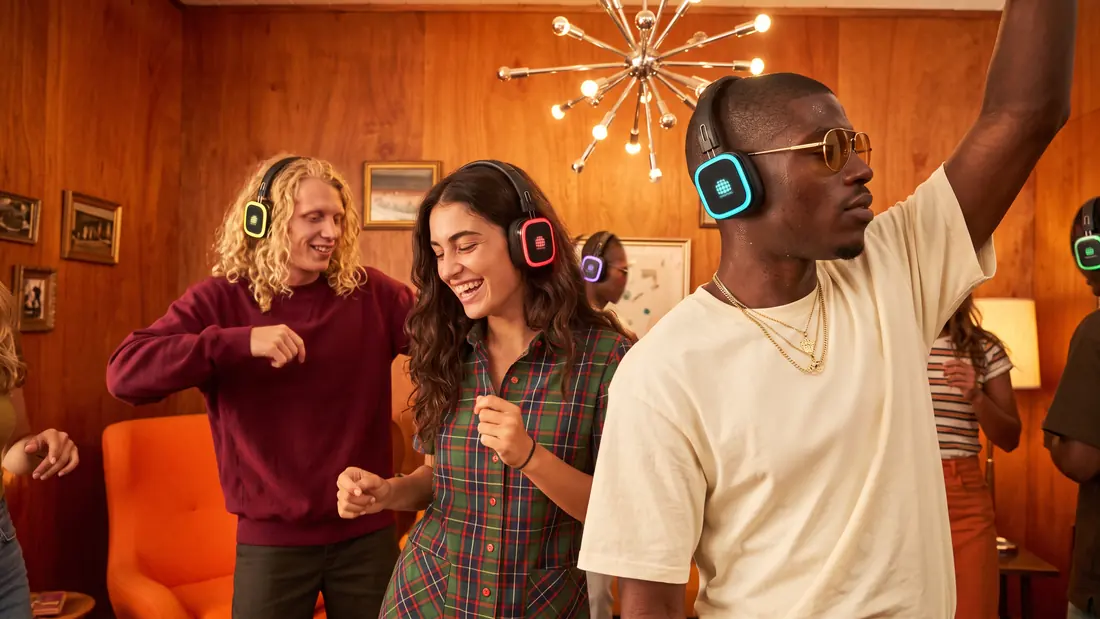
A silent disco is a party where the music plays through wireless headsets instead of speakers. The crowd dances to the beat, but the room stays quiet. Take your headset off and all you hear is feet on the floor and people singing along.
If you are new to the idea, this guide covers how it works, what you need and where it fits.
The ideaMusic by radio, not by speakers
A laptop, phone or DJ mixer plugs into a transmitter through an AUX or RCA cable. The transmitter sends the music out by radio, and every headset in range picks it up.
Guests do not pair anything. They switch the headset on and the music is there. Setup is the same for 10 guests or 200, because one transmitter feeds every headset in range.
The idea is older than most people think. Read the full story on our silent disco history page, or go deeper into how the technology works.

ChannelsWhy the headsets glow in colours
Nokomoto headsets work on 2 or 3 channels. Each channel can carry different music, and guests switch between them on the headset.
The headset light shows the channel. So you can look across the floor and see which music is winning. Friends can stand side by side, dance to different songs and still be at the same party.
Each live channel needs its own music source and its own transmitter. One DJ needs one transmitter. Three DJs need three.
UsesIt is not only for dance floors
- Weddings and sangeets: a dance floor that does not fill the whole venue with sound.
- College fests and farewells: two or three music choices keep a mixed crowd happy.
- Clubs, cafes and rooftops: a party for spaces where loud speakers are a problem.
- Yoga and fitness: the trainer and the music reach every person directly, indoors or out.
- Seminars and corporate events: the Lyrx app adds live translation for mixed language groups.

Your kitWhat you need to run one
- Headsets: one for each person wearing one at the same time, plus a few spares.
- Transmitter: one for each music source. Transmitters run from 200M to 500M.
- Music source: a laptop, phone or mixer with an AUX or RCA output.
- Charged batteries: SquareTune runs 8 to 10 hours (250M model 8+) and OvalTune 9+ hours. Charging takes roughly 2 to 4.5 hours, depending on the model.
Headsets come in two styles, SquareTune and OvalTune, in 250M, 300M, 400M and 500M range models. The 250M is SD audio and the others are HD. Range figures are for open space. Walls, crowds and buildings reduce them, so leave some headroom.
Nokomoto headsets and transmitters are BIS and WPC certified and ship across India. Single headsets start from ₹4,900 plus 18% GST. Prices can change, so check the shop before you plan your budget. Shop headsets
LimitsWhat a silent disco will not do
- You do not feel the bass in your chest the way you do near big speakers.
- Someone has to hand out and collect headsets. The Tago app makes hand-out faster.
- Some guests will not want to wear one, so keep a space for them too.
- Crowds still make noise. People sing and cheer, often louder than they realise.
Quick answersWhat first-timers ask
Can people nearby hear the music?
With no speakers, there is no music playing in the room. People nearby will still hear the crowd singing and cheering.
Can guests use their own headphones?
No. Normal headphones, including most Bluetooth ones, are not made for this. Guests use silent disco headsets that receive the transmitter signal.
Can I try it on a small scale first?
Yes. The Demo Kit has 1 headset and 1 transmitter for ₹19,500 plus 18% GST. Packs start at 5 headsets.
Is a silent disco allowed late at night?
It depends on your venue, city and state. Read our note on noise restrictions, then confirm with your local police or authority before you book.